Thursday, May 25, 2017
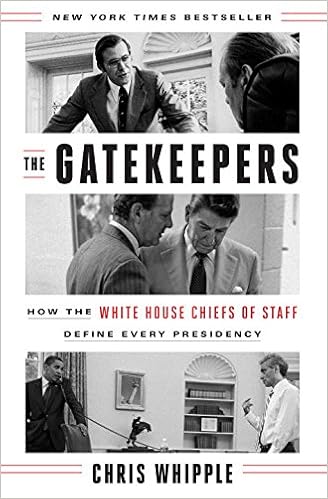 The Gatekeepers: How the White House Chiefs of Staff Define Every Presidency by Chris Whipple examines the modern chief of staff and how every presidency since Nixon's has been shaped by the position. Good or bad, the chiefs of staff have been one of the most influential factors in the legacy of each presidency in the modern era.
Whipple uses mainly primary source material to tell the magnificent tale of the modern chief of staff. He conducted numerous interviews with the chiefs as well as two former presidents. He also had access to previously unpublished material granted him by the individuals involved. How a chief shapes the presidency is the overall theme of this book and the thread that ties each individual story together.
It is the chief of staff's job to protect the president's time. How well he does that plays a significant role in the president's success. He is also to manage the staff and stop anyone trying to go around the proper channels, or trying to execute plans that are just bad ideas such as the Watergate break-in, or the Iran-Contra affair. The chief has to be able to be 100% honest with the president and manage many strong personalities at once.
Whipple tells the story of each chief both from their perspective as well as those who worked with them. At the end of each chapter, I was left wanting to know more about these men and their relationships, as there is only enough space to discuss the high (or very low) points of each chief's time in office. The Gatekeepers is very readable and easy to understand, even for someone who isn't familiar with politics. Part biography, part modern American history, The Gatekeepers is a great read for anyone interested in either.
Blogging for Books provided this book to me for free in exchange for an honest review. I was not required to write a positive review. The opinions I have expressed are my own. I am disclosing this in accordance with the Federal Trade Commission's 16 CFR, Part 255

Tuesday, May 16, 2017

The Dawn of Christianity: How God Used Simple Fishermen, Soldiers, and Prostitutes to Transform the World by Robert J. Hutchinson uses biblical and extra-biblical sources to historically trace the beginning of "the Jesus movement." Hutchinson starts from a bit before the birth of Jesus and goes through the Jerusalem council.
Each chapter is short and deals with one particular person or event in the formation of Christianity. The writing flows well and is easy to read and understand. There are numerous helpful end notes at the back of the book that provide either sources or more detail, some of which is very interesting.
There isn't really anything new in this book, but it does serve as a great introduction to an important topic for both believers and skeptics. It is organized and informative without going so deep into any one particular topic or scholarly controversy that someone new to the topic would become bogged down. Overall, I recommend The Dawn of Christianity to anyone interested in how Christianity was formed and took root.
I received this book free from Thomas Nelson Publishers as part of their BookLook book review bloggers program. I was not required to write a positive review. The opinions I have expressed are my own. I am disclosing this in accordance with the Federal Trade Commission's 16 CFR, Part 255
Monday, May 1, 2017
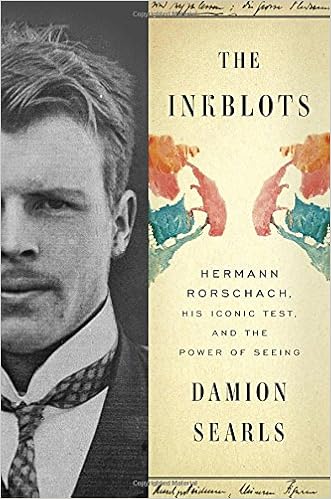
The Inkblots: Hermann Rorschach, His Iconic Test, and the Power of Seeing by Damion Searls is part biography, part history of one of the most famous psychological tests of all times. By examining both the history of the Rorschach test, as well as the life of it's creator, Searls provides a comprehensive look at how the test has both shaped, and been shaped by, culture and popular thought.
Hermann Rorschach was one of the most interesting figures of his time. Peers with men such as Freud, Jung, and Bleuler, Rorschach was able to take the best from all of them, and add thoughts of his own without getting stuck in any one box or school of thought. His open mindedness as well as his not only willingness but desire to see as other's see allowed him to begin to tap into the potential of the human mind. He somewhat stumbled upon what would become his most famous and lasting contribution to his field. Once he realized the great potential of his inkblot "experiment" (as he called it), he spent the rest of his life refining and improving it. If Rorschach had had more time, the potential for what his test could have accomplished is unlimited.
The test itself has weathered far more storms than its creator could have ever imagined. One of the most interesting aspects of Searls examination of the test is how it was shaped not only by trained psychologists, but also by things such as the standardization of medicine in America and the wars between interpretation and hard data. The beauty and simplicity of the test continues to be lost and rediscovered as it is forced into roles it was never created to fill and then reemerges once again to reclaim itself.
Searls' combination of Rorschach's biography and history of his inkblot test provides a thorough and comprehensive look for the layman. There are some parts that are a bit technical, but they are necessary to explain various controversies and interpretations. Overall, The Inkblots is engaging and easy to read both in its pace and clarity. I'd recommend The Inkblots to anyone interested in psychology, the Rorschach test itself, or simply how things are shaped by forces beyond their creator's control or imagination.
Blogging for Books provided this book to me for free in exchange for an honest review. I was not required to write a positive review. The opinions I have expressed are my own. I am disclosing this in accordance with the Federal Trade Commission's 16 CFR, Part 255
Monday, April 3, 2017

Wear worked for both Obama presidential campaigns and worked as a staffer in The White House Office of Faith-Based and Neighborhood Partnerships during Obama's first term. Wear briefly describes his life before entering the political sphere, before moving on to chronologically discussing events he was involved with in the first campaign and term of the Obama administration. He then covers key policies involving faith and the faith community including abortion and same sex marriage. He then moves on to his involvement in the second presidential campaign and then ends with a broad discussion of how politics and faith can work together.
As a whole, the tone of Reclaiming Hope toward President Obama and his administration is even handed. The first half is almost all positive and almost has a feel of there being no room for criticism, but the second half addresses controversy and legitimate criticism, giving the book as a whole balance. The discussion about faith and politics is constructive and beneficial for any person of faith in America. Recognizing that ultimate hope lies with God, His people still have to engage with the structures of power here on earth. Wear seems to have managed that balance well in his own life, and has made a career of helping others do so as well.
Overall, I'd recommend Reclaiming Hope by Michael Wear to those interested in the faith of President Obama, and/or anyone interested in the intersection of faith and politics in America.
Blogging for Books provided this book to me for free in exchange for an honest review. I was not required to write a positive review. The opinions I have expressed are my own. I am disclosing this in accordance with the Federal Trade Commission's 16 CFR, Part 255
Thursday, March 16, 2017

How to Overcome Worry: Experiencing the Peace of God In Every Situation by Dr. Winifred Neely is a short, practical guide to dealing with worry and anxiety. Based on a sermon Dr. Neely preached out of the book of Philippians, How to Overcome Worry is a great resource for Christians dealing with what can be a confounding topic.
Dr. Neely equates anxiety and worry, which he defines as, "concern turned inward and deformed, divorced from the grace of God and rooted in unhealthy fear" (pp. 29-30). He makes the helpful distinction between worry, proper concern, and clinical anxiety, noting that concern is appropriate, and a normal part of life and clinical anxiety is the result of living in a fallen world.
Using Paul's letter to Philippi, Dr. Neely provides tips to overcome worry. Keeping one's focus on God by using prayer and scripture meditation, Dr. Neely says that we can find God's peace which, "is the awesome well-being, the glorious serenity, the inexpressible wholeness, and the inner tranquility that characterize the infinite being of God Himself" (p.68).
As one who has dealt with anxiety, I found How to Overcome Worry extremely helpful. It is practical, biblical, and doesn't trivialize or dramatize the subject. It is short and easy to read, and is a great resource for Christians dealing with the topic.
I received this book free from Moody Publishers as part of their Moody Publishers Blogger Review Program. I was not required to write a positive review. The opinions I have expressed are my own. I am disclosing this in accordance with the Federal Trade Commission's 16 CFR, See Part 255
Thursday, March 9, 2017
 Enjoy: Finding the Freedom to Delight Daily in God's Good Gifts by Trillia J. Newbell is about learning to enjoy all of the gifts of life God has given us. Newbell discusses nine different areas of life such as work, possessions, and creation in which children of God can find delight in Him.
Newbell does a good job of pointing out the broad ideas of enjoyment in each area without crossing into legalism. She always does a good job of mentioning common objections which can prevent people from finding enjoyment in each area. At the end of each chapter, there is something called "The Enjoy Project" that gives practical steps to take to find more enjoyment in the area of life the chapter discusses. Newbell advises the reader at the beginning to keep a journal, or do "The Enjoy Project" with a partner or small group for accountability. There are also discussion questions in the back to use if one does go through Enjoy with a small group.
Overall, Enjoy is a good resource for those who take themselves too seriously, or who have a hard time consistently enjoying life. Joy needs to be cultivated, and this book is a great resource for that.
Blogging for Books provided this book to me for free in exchange for an honest review. I was not required to write a positive review. The opinions I have expressed are my own. I am disclosing this in accordance with the Federal Trade Commission's 16 CFR, Part 255

Monday, February 27, 2017

Nyquist begins by defining justice. He then discusses reasons humans find justice hard to accomplish. The next section discusses how justice should be done, and the last asks the question of whether justice will ever be realized.
Is Justice Possible? includes anecdotes about justice not being done, or being delayed significantly. It also includes basic definitions and different ways American Christians can pursue justice in political, public, and personal arenas. This is probably the most helpful section.
Overall, Is Justice Possible? is an easy read. It is a thin book that serves as a basic introduction to the topic. Those who have never given justice more than a passing consideration will find reading this beneficial.
I received this book free from Moody Publishers as part of their Moody Publishers Blogger Review Program. I was not required to write a positive review. The opinions I have expressed are my own. I am disclosing this in accordance with the Federal Trade Commission's 16 CFR, See Part 255
Subscribe to:
Posts (Atom)