Showing posts with label American history. Show all posts
Showing posts with label American history. Show all posts
Tuesday, June 21, 2016
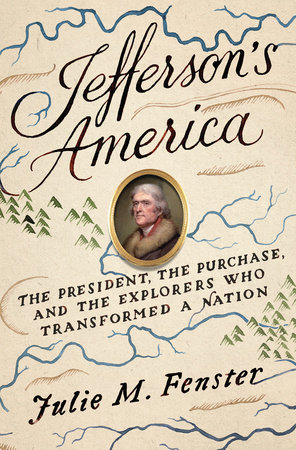
Jefferson's America: The President, the Purchase, and the Explorers who Transformed a Nation by Julie M. Fenster tells the story of the six men who first explored the new American territory west of the Mississippi River. When Thomas Jefferson first acquired the Louisiana Purchase, not everyone was impressed. Many thought it was more trouble than it was worth. There was some basis for this opinion, as there were no clearly marked borders between where American territory ended and Spanish territory began. This caused tensions between the two countries that almost led to war.
Jefferson chose to combat both the apathy of his own people regarding the land, and the tension with Spain in a somewhat unconventional way. Instead of a huge show of military strength, Jefferson sent explorers on four major expeditions. He hoped the explorers would bring back reports of the richness of the new land. He also wanted them to bring back examples of new plant and animal specimens so people could see the benefit of the new land for themselves. Jefferson hoped that once he had something to report, congress would give him more money for further exploration, and more people would be on board with his purchase.
The explorers were also told to establish contact with any native groups they came across. This was intended to establish both an American presence, and hopefully, dominance in their new land. Lewis and Clark are the men most remembered for their heroic journey to the Pacific and back. While they deserve credit for what they accomplished, there were other men who did just as much on their journeys. Zebulon Pike, Thomas Freeman, Peter Custis, William Dunbar, and Dr. George Hunter took just as many risks and did just as much for establishing American territorial borders and engaging the interest of the American people in their new land.
Jefferson's America offers a comprehensive and easily understandable look at the above men and their journeys. Each man (including Jefferson) gets the same level of treatment, as does each expedition. The importance of each is highlighted, as is the strength and weakness of each man. The motivations of the explorers is also discussed. Fenster gives a great overall look at the political, social, and economic, and international factors in play in the Louisiana territory during the early 1800s. I'd recommend this book to anyone interested in Thomas Jefferson, early American history, or exploration and the people who lead it.
Blogging for Books provided this book to me for free in exchange for an honest review. I was not required to write a positive review. The opinions I have expressed are my own. I am disclosing this in accordance with the Federal Trade Commission's 16 CFR, Part 255

Monday, September 28, 2015

Robert Bunch helped shaped Britain's views of the American South and it's "peculiar institution" during a time when the stakes were high. Britain had abolished slavery in its country and was attempting to end the slave trade world wide. This was one of their leading causes during this time, and most of the conflict in this area was occurring right where Bunch worked and lived. The delicate political situation of recognizing the Confederate States of America or not eventually led to Bunch's removal from Charleston.
Our Man in Charleston tells an interesting story, just not quite the one I expected. I expected it to be more espionage related, based on the title. However, Bunch was a diplomat through and through. While maintaining his personal views while at the same time maintaining relationships with those around him did require a certain amount of subterfuge, it was more diplomatic in nature. This book is heavy on description and narration, which makes its pace somewhat slow. Someone more interested in diplomatic maneuverings would probably appreciate it more than I did. I'd recommend this book to anyone interested in foreign involvement in American history in the fifty years or so leading up to the Civil War.
Blogging for Books provided this book to me for free in exchange for an honest review. I was not required to write a positive review. The opinions I have expressed are my own. I am disclosing this in accordance with the Federal Trade Commission's 16 CFR, Part 255
Wednesday, August 26, 2015

The Printer and the Preacher: Ben Franklin, George Whitefield, and the Surprising Friendship that Invented America by Randy Petersen examines the somewhat unlikely friendship that spanned decades of each man's life. Using historical sources, including letters written between the men, Petersen lays out the trajectory of each man's life and how the overlap of their lives helped shape American history.
Petersen gives a thumbnail sketch of each man's life before their first interaction, but the majority of the book is spent discussing how Whitefield and Franklin influenced and helped one another. The way each life is presented, Petersen is trying to get the reader to see many parallels between them. He points out similarities in social standing, success, and thought, especially about engaging with and bettering one's community. The main difference was that Franklin thought the solution to all of society's woes was in civic engagement, and Whitefield thought the solution was Jesus.
The similarities Petersen points out are interesting, though some of them seem like somewhat of a stretch. Whitefield and Franklin did seem to have a symbiotic relationship that made both of them more successful than they could have been alone. It's clear they had a deep respect and affection for one another, though their opinions on many matters varied, sometimes widely. It's an overstatement to claim their friendship "invented America," but it does seem to have been an important relationship that is often overlooked when examining America's history.
The Printer and the Preacher is an interesting book about the friendship of two historically significant men. The pace is somewhat slow, and some of the connections feel forced. There is a fair amount of repetition and conjecture, though Petersen is good about pointing out what are just his thoughts. Overall, anyone who is a fan of early American history or of the first Great Awakening will find this an interesting, if not quite engaging, read.
I received this book free from Thomas Nelson Publishers as part of their BookLook book review bloggers program. I was not required to write a positive review. The opinions I have expressed are my own. I am disclosing this in accordance with the Federal Trade Commission's 16 CFR, Part 255
Subscribe to:
Posts (Atom)