Showing posts with label WWII. Show all posts
Showing posts with label WWII. Show all posts
Wednesday, October 10, 2018

Auschwitz Lullaby by Mario Escobar is a fictionalized version of the real life story of Helene Hannemann, a German mother who chose to go to a concentration camp, and ultimately death, with her Romani family.
When she was young, Helene, a young German woman, married a man of Romani heritage and had five children with him. Though she hoped to escape the notice of the Nazis, in 1943 they came to take her husband and children to Auschwitz because of their Romani heritage. Since she was purely German, she was allowed to stay free. However, she would not allow her husband and children to go without her, so she voluntarily went to Auschwitz with them.
Helene was able to receive slightly better treatment in the camp because of her background as a nurse as well as her German heritage. Dr. Josef Mengele asked her to run a daycare for the Romani children in the camp. Helene uses every ounce of courage and "favored" status she can to create a bit of light for the children in such a dark time. Despite this strange relationship with Dr. Mengele, in the end, her whole family is put to death not long before the Allies liberate the camp.
Escobar does an amazing job of telling the story of Helene Hannemann in a easy to related to fashion. Auschwitz Lullaby flows extremely well and is so compelling it is hard to put down. I would recommend this book to anyone interested in the daily life of concentration camp prisoners, as well as anyone who enjoys stories of human courage and perseverance.
I received this book free from Thomas Nelson Publishers as part of their BookLook book review bloggers program. I was not required to write a positive review. The opinions I have expressed are my own. I am disclosing this in accordance with the Federal Trade Commission's 16 CFR, Part 255

Wednesday, July 18, 2018

Throughout this book, the reader goes on two journeys with Anderson. The first is discovering what in Anderson's past is driving her current actions. The second is how the case she's involved in relates to a mystery in the area's past. As people start dying, both Anderson and the reader are unsure to which mystery the deaths are linked. Parks leaves that mystery until the very end, wrapping everything up in the last few chapters.
Overall, Formula of Deception is an enjoyable read. I wish there had been a been more detail given at the end when everything is wrapped up. The ending felt a bit rushed and not completely wrapped up. However, that doesn't take away from the excitement of the rest of the book.
I received this book free from Thomas Nelson Publishers as part of their BookLook book review bloggers program. I was not required to write a positive review. The opinions I have expressed are my own. I am disclosing this in accordance with the Federal Trade Commission's 16 CFR, Part 255
Tuesday, February 13, 2018

It is astonishing how small the world was after WWII and how one nation's support or lack thereof can shape the destiny of another nation. The steep toll paid by China during WWII created a kind of vacuum that Mao was able to exploit. America's support for the nationalists, which had been strong during Truman's first term, was quickly withdrawn during his second under the direction of Secretary of State Dean Acheson. While there were many other factors that played into Mao's victory, this was a significant one. The subsequent policy of containing communism in the rest of Asia led to American involvement in two more significant conflicts.
Peraino does a good job of delving into these policies and the people behind them without getting bogged down in minutiae. A Force So Swift is easy to read and flows well. The balance between policy and personality is such that one doesn't get trapped in either. It is informative and somewhat entertaining.
Blogging for Books provided this book to me for free in exchange for an honest review. I was not required to write a positive review. The opinions I have expressed are my own. I am disclosing this in accordance with the Federal Trade Commission's 16 CFR, Part 255
Wednesday, October 4, 2017
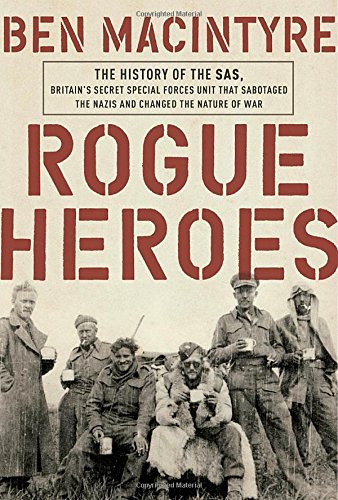 Rogue Heroes: The History of the SAS, Britain's Secret Special Forces Unit That Sabotaged the Nazis and Changed the Nature of War by Ben Macintyre is a fascinating look at the beginning of modern special forces as the western world knows them.
The men who created the Britain's Special Air Service were rugged, action oriented men who had little patience for bureaucracy that kept them from the battlefield. David Stirling was part of a unit that was supposed to act as a commando unit but was constantly standing down before actually going on missions due to one bureaucratic reason after another. Frustrated, Stirling sought and got permission to form a unit of his own. It was much smaller and while the hierarchy was sometimes murky at the beginning, operational control would at first remain with Stirling. This unit was formed specifically to attack Rommel and his forces from behind enemy lines. They were successful not only in causing physical destruction on the North African front, but psychological terror as well.
The specifics of how exactly that all came together as well as how the SAS transferred from North Africa to Europe is the content that makes up Rogue Heroes. Certain men who played a bigger role are given more space while others just have their name listed. However, there is a full honor roll in the back with the names and ranks of all the men involved in the original unit. Rogue Heroes also includes many photos of some of the main men as well as some from the SAS diary.
All in all, Rogue Heroes is a fast paced story about men who stood tall in WWII and changed the face of modern warfare. Macintrye's writing flows well and is easy to follow along with. He makes complicated topics easy to understand and allows the reader to almost feel as though one is part of the original SAS crew. Anyone interested in military, WWII, or special ops history will find Rogue Heroes a fascinating and satisfying read.
Blogging for Books provided this book to me for free in exchange for an honest review. I was not required to write a positive review. The opinions I have expressed are my own. I am disclosing this in accordance with the Federal Trade Commission's 16 CFR, Part 255
Tuesday, September 13, 2016

Dr. Sumner Jackson was an American who had served in the American Red Cross Hospital of Paris during WWI. He was married to a Swiss woman named Toquette and they had a 12 year old son named Phillip at the time of WWII. As the Nazi's marched toward Paris, Jackson was put in charge of the hospital as many of his colleagues decided to go home. Dr. Jackson helped the cause of the Resistance before the Nazis even got to Paris. He hid an American spy until he could escape under new papers.
I don't want to spoil what happens, so I'll stop there, but the rest of the book continues the story of this remarkable family and how each one contributed to the cause of defeating the Nazis. Kershaw tells their story in such a way that one feels one is reading a thriller. The suspense builds as the story unfolds.
Anyone interested in WWII in general, or the French Resistance in particular will find this a thrilling read. Even those who don't consider themselves history buffs will enjoy Avenue of Spies. It is a very entertaining story that has the bonus of being about true heroes.
Blogging for Books provided this book to me for free in exchange for an honest review. I was not required to write a positive review. The opinions I have expressed are my own. I am disclosing this in accordance with the Federal Trade Commission's 16 CFR, Part 255
Saturday, July 23, 2016

The central characters of The Witnesses are a young lawyer and his grandfather, who served in the German army during WWII. Both have a gift of seeing into the future. While the grandfather is haunted by how he has used his gift, the young lawyer struggles with how to use his gift in his career.
The Witnesses isn't quite as legal thriller as some of Whitlow's earlier novels. While the law is involved, the focus is more on the gift of seeing into the future and how to responsibly use that gift. Still, it's an engaging read with relatable characters. The blend between the present and the past is well done and not at all confusing. The imagery and secondary theme of second chances were refreshing and encouraging.
Those who have enjoyed Whitlow's other novels will enjoy The Witnesses, while those who are only interested in straight legal thrillers may not.
I received this book free from Thomas Nelson Publishers as part of their BookLook book review bloggers program. I was not required to write a positive review. The opinions I have expressed are my own. I am disclosing this in accordance with the Federal Trade Commission's 16 CFR, Part 255
Tuesday, December 1, 2015

The relationship between the Churchills and the Kennedys spanned three generations, two continents, and one world war. While the families briefly met socially in the late 1930s, their relationship really started when Joseph P. Kennedy was appointed the U.S. ambassador to the Court of St. James. When Lions Roar gives some background information on the patriarch of each family, but the majority of the book centers on the official roles that brought these two families together, and how those roles and relationships affected the relationship of the U.S. and Britain. It chronicles both the public and private ups and downs of the relationships mainly among Joe Kennedy Sr., Winston Churchill, Randolph Churchill, and John F. Kennedy, though other family members and their interactions are also mentioned.
When Lions Roar is a fascinating read. It is very well written and though it is full of detail and quotes from both spoken and written texts, the pace never gets bogged down. Maier focuses on two main relationships throughout this book. The main focus of course is on the relationship between the two families. However, there is a secondary focus on the relationship within each family, particularly that of father and son. How the two fathers interacted with their children was quite different. Towards the end of the book, Maier briefly explores how these different types of interactions produced very different kinds of sons.
Anyone interested in either family will find When Lions Roar a satisfying read. So will those interested in the relationship between the U.S. and Britain, especially leading up to and during WWII.
Blogging for Books provided this book to me for free in exchange for an honest review. I was not required to write a positive review. The opinions I have expressed are my own. I am disclosing this in accordance with the Federal Trade Commission's 16 CFR, Part 255
Tuesday, March 24, 2015

Mouillot grew up extremely close to her grandmother, and couldn't fathom never knowing about this huge part of her life. Her natural inclination toward history led her to figure out what happened. Mouillot moved to France after college to live in a house her grandparents bought together in a small village in France. She thought this would help her search for the truth. Using nothing more than her grandparent's official refugee documents from WWII and the few memories she could get her grandparents to part with, she pieced together the story neither one of them could, or would, remember.
Mouillot is an engaging writer. She easily draws the reader into the mystery surrounding her family history. Weaving together the past and her present search for her, Mouillot makes the reader feel as if he/she is a fly on the wall as she searches. I felt her frustration as she hit dead end after dead end. As she finally the realized the truth, I felt some of the wallop that she must have felt as she realized her family's history and happiness was simply another causality of war.
I recommend A Fifty Year Silence to any person interested in family history, the effect of WWII on European Jews who managed to stay out of concentration camps, or anyone interested in how the past influences and informs the present.
Blogging for Books provided this book to me for free in exchange for an honest review. I was not required to write a positive review. The opinions I have expressed are my own. I am disclosing this in accordance with the Federal Trade Commission's 16 CFR, Part 255
Tuesday, February 3, 2015
 My Battle Against Hitler: Faith, Truth, and Defiance in the Shadow of the Third Reich by Dietrich von Hildebrand and John Henry Crosby is a collection of memoirs and scholarly works by one of the staunchest intellectual opponents of Adolf Hitler and Nazism. Von Hildebrand was a respected Catholic philosopher who taught at the University of Munich. He was such a fierce opponent of Nazism, even before anyone outside of Germany was really paying attention, that he found himself on several Nazi death lists. In fact, his stance led to his having to flee from Germany, and later from Austria, because he was marked for death.
Crosby took memoirs written by von Hildebrand for his second wife, and translated and edited them into somewhat of a narrative style that covers von Hildebrand's life in the 1920s and 1930s. Crosby adds some historical context to von Hildebrand's memoirs, which helps the reader better understand von Hildebrand's words. The first half of the book is taken from von Hildebrand's informal memoirs and is broken down by year, with portions of context preceding each change in subject. The second half of the books is comprised of articles and excerpts of articles von Hildebrand wrote against Nazism and antisemitism. Most of these articles were originally written for Der Christliche Ständestaat (The Christian Corporative State) the journal von Hildebrand headed up while he was in Austria; the stated purpose of this journal was to combat Nazism specifically and nationalism in general on an intellectual level.
I am amazed that I had never heard of Dietrich von Hildebrand before reading this book. He seems to have been such an influential opponent of Hitler and Nazism, that I wonder why he isn't more widely known. I really enjoyed reading about his life in his own words. Crosby did a great job of adding just enough notes and context to make sense of von Hildebrand's words without adding anything unnecessary. He recognizes that von Hildebrand's work is strong enough to stand on its own. The second half wasn't quite as easy to read as the first, as it was written on more of a scholarly, philosophical level. I understood enough to know that he was brilliant and would be a worthy opponent of any ideology he didn't agree with.
I recommend this book to anyone interested in WWII, philosophy, Catholic intellectual life, or Europe in the time between the world wars.
Blogging for Books provided this book to me for free in exchange for an honest review. I was not required to write a positive review. The opinions I have expressed are my own. I am disclosing this in accordance with the Federal Trade Commission's 16 CFR, Part 255
Friday, January 9, 2015

No Greater Valor: The Siege of Bastogne and the Miracle That Sealed Allied Victory by Jerome Corsi is an account of the siege of Bastogne. This occurred during the Battle of the Bulge, the last major German offensive of WWII. The 101st and 82nd Airborne divisions were sent to Bastogne at the last minute after their post leave was cut short. They were sent without adequate supplies, and under the command of a new general because of a last minute switch. This illustrates the desperation of the situation unfolding at the beginning of the offensive.
The focus of No Greater Valor is slightly unclear. The subtitle and introduction make it seem as though the focus will be the religious aspect of the siege seen through the faith of those involved and how they interpreted events. While there are some mentions off faith throughout, they are random and not the main focus. The main focus seems to be just a recounting of events. There is little to no background information given, and as a reader not familiar with the specifics of battles in WWII, I found myself struggling to keep up at first. It was somewhat like being thrown into the deep end and told to swim. There was also a lot of technical military terminology without any explanation or reference chart. The content itself is good, but how the book is advertised is misleading. In cases like this, a disservice is done to the reader.
Overall, anyone who enjoys military or WWII history will probably enjoy No Greater Valor, though its not really the best book for one unfamiliar with either topic.
I received this book free from Thomas Nelson Publishers as part of their BookLook book
review bloggers program. I was not required to write a positive review. The opinions I have expressed are my own. I am disclosing this in accordance with the Federal Trade Commission's 16 CFR, Part 255
Monday, September 22, 2014

Philby lived an incredible life full of colorful characters. Macintrye chooses to frame his telling of this life with a friendship - that of Kim Philby and fellow MI6 agent Nicholas Elliott. Throughout their entire career, Elliott was Philby's most faithful supporter and friend, even during the later years that were full of suspicion and accusations. A Spy Among Friends, a title with a clever hidden meaning, traces Philby's development from a communist sympathizer in college to a full blown double agent whose deception led to hundreds of deaths and unsuccessful missions to thwart communism. For the first twenty or so years of his career, not one person suspected his deception as he moved up the ranks of MI6.
I have never heard of Ben Macintyre before, but after reading this, I am a huge fan. This wasn't just a good book; it was a great read. It was factual and informative, but read like a best-selling novel. Macintyre's choice to frame the story of Philby's life in his friendship with Nicholas Elliott makes the reader feel the impact of Philby's betrayal on a more visceral level. Though I knew the outcome from the start, I found myself amazed at the culture of MI6 that allowed Philby access to so many more secrets than he would have had from just his own work. This same culture averted suspicion from Philby and allowed him to escape several close calls.
I would recommend this book to anyone interested in WWII or Cold War history, as well as anyone interested in spycraft or its history. I plan on finding Ben Macintyre's other books and throroughly enjoying them while also learning as much as I did while reading A Spy Among Friends.
Blogging for Books provided this book to me for free in exchange for an honest review. I was not required to write a positive review. The opinions I have expressed are my own. I am disclosing this in accordance with the Federal Trade Commission's 16 CFR, Part 255
Monday, December 16, 2013

Hoffman does a good job of blending fact and fiction. While it is understood that the characters and the circumstances that brought them to the camp are fictional, everything else, including everything that happens in the camp is based on fact. When a particularly hard to believe incident occurs, Hoffman provides documentation that the incident actually happened in the form of a footnote at the bottom of the page. As familiar as I felt I was with the atrocities of the concentration camps, I was not prepared for some of the details of experiments Dr. Mengele performed. I appreciate the fact that Hoffman represented the historical figures with attention to historical detail.
The Holocaust in general, and what Dr. Mengele did in particular are difficult topics to discuss. Hoffman's creation of a fictional family that experiences these things actually helped ground them in reality for me. Some of them are so horrific and beyond human thought that had I read about them on their own, without the association of the narrative, I don't know that they would've had the same impact. Hoffman does a great job of providing historical fact while also telling a compelling story that raises important questions about faith and hope. While it is a difficult read that requires a mature reader, I would recommend Samson: A Savior Will Rise to anyone interested in WWII, the Holocaust, or simply important questions about how faith and hope are shaped among the worst of circumstances.
I received this book free from Thomas Nelson Publishers as part of their BookSneeze book review bloggers program. I was not required to write a positive review. The opinions I have expressed are my own. I am disclosing this in accordance with the Federal Trade Commission's 16 CFR, Part 255
Monday, May 6, 2013

Lutzer, a pastor and theologian, structures his book in a logical, chronological order. He examines the history of the German people and the German church which helps explain the state both were in when Adolf Hitler and the Nazis came on the scene. The book is set up as a conflict between two crosses and two saviors: Christ and the cross, and Hitler and the swastika. Lutzer shows how Hitler and the swastika came to reign over Christ and the cross in Germany for a period of time. However, he makes sure to point out that God was always in control and that He was and is the ultimate victor. The swastika may have "reigned" for a bit, but Christ and the cross were never beaten. This is mainly highlighted through the life and efforts of Dietrich Bonhoeffer and the Confessing Church.
Overall, the book was OK. I was a bit taken back by the preachiness of the commentary about modern day America and the parallels the author sees between now and Nazi Germany. I expected more of a straightforward historical account, and found the continual interjections somewhat disrupting. Other than that, Hitler's Cross contains good information, and I would recommend it to anyone interested in WWII, church history, or sociology.
I received this book free from Moody Publishers as part of their Moody Publishers Blogger Review Program. I was not required to write a positive review. The opinions I have expressed are my own. I am disclosing this in accordance with the Federal Trade Commission's 16 CFR, Part 255
Thursday, February 23, 2012
 Drinking a fine, aged wine. Hearing one of Chopin's sonatas played by a world class pianist. Seeing the ceiling of the Sistine Chapel in person. Smelling your favorite home cooked meal cooking on mom's stove after a long time away. These experiences can leave us with a sense of well-being, satisfaction, accomplishment, and sometimes as if we've experienced a small slice of something not quite of this world. Reading Bonhoeffer: Pastor, Martyr, Prophet, Spy by Eric Metaxas left me with this kind of feeling.
Putting aside the content for a minute, Metaxas' use of the English language in this book is masterful. As someone who enjoys words and the power of language, I was consistently impressed, inspired, and honestly sometimes in awe of the elegance and power of Metaxas' prose. For example, while giving background information on Germany and the German church that shaped Bonhoeffer, Metaxas writes:
"Luther's influence cannot be overestimated. His translation of the Bible into German was cataclysmic. Like a medieval Paul Bunyan, Luther in a single blow shattered the edifice of European Catholicism and in the bargain created the modern German language, which in turn effectively created the German people. Christendom was cleft in twain, and out of the earth beside it sprang the Deutsche Volk" (p. 20).Writing like this inspires me. It is a pleasure to read something of significance in both subject and style.
From a biographical standpoint, Bonhoeffer is on par with greats such as John Adams by David McCullough or The Hiding Place by Corrie Ten Boom. Everyone is shaped by his/her environment to varying degrees, therefore any good biography will include information not just about the subject, but about the people and events that helped shape him/her as well. There is a fine line between giving too much information and too little; it is also sometimes difficult to filter through the vast amounts of information and present only those people/events of importance. Metaxas walks this line perfectly throughout most of Bonhoeffer. The early family history is a little heavy, but every other area is given just enough attention to better appreciate Bonhoeffer's life.
Bonhoeffer was shaped by his family and world events more than the average person; without being raised in such an extraordinary family and intellectually rich and diverse environment, Bonhoeffer would never have been able to walk the tight rope he walked so effectively in many areas. His incredibly nuanced thinking allowed him to maintain positions many found untenable. This was not due to clever mental gymnastics in order to justify whatever it was he wanted; instead, it was an ability to understand and consider ever conceivable side of an issue in such an effective way that his reasoning was always intellectually sound. In truth, though he was quite capable of such mental exercises, his view of the life and duty of a Christian would never allow him to go such a route. In a letter to a brother-in-law he once wrote,
"If it is I who determine where God is to be found, then I shall always find a God who corresponds to me in some way, who is obliging, who is connected with my own nature. But if God determines where he is to be found, then it will be in a place which is not immediately pleasing to my nature and which is not at all congenial to me. This place is the Cross of Christ. And whoever would find him must go to the foot of the Cross, as the Sermon on the Mount commands" (p. 137).Metaxas helps the reader understand how such nuanced, yet at the same time disciplined, thinking was possible for Bonhoeffer, with his thorough description of the environment that shaped Bonhoeffer growing up. The description of his environment, and the environment itself, is so rich that after reading the first few chapters, the reader almost feels as though he/she has visited the house in Berlin's Grunewald district that was always full of music, people, culture, and intellectually stimulating discussion.
There is enough written in Bonhoeffer about the German people, their history, and psyche that those who are interested in Germany or the German people as a whole from WWI to WWII will also find Bonhoeffer an enjoyable read. History goes to the victor; because of this, many Americans have at least a slightly negative view of all Germans from this era, as if they all knew of and supported everything Hitler was doing. The truth is, many Germans were opposed to and actively fought against Hitler from the beginning; many millions more joined as the atrocities grew and the truth became known. Even the majority of the regular German soldiers fought in support of, and out of loyalty to, the German fatherland, not Adolf Hitler and the Nazis. The Nazi party and the German people are not indistinguishable, and Metaxas makes this very clear in Bonhoeffer.
Bonhoeffer will also be of interest to those interested in Christian theology, specifically that of the 20th century. Almost on accident, Bonhoeffer became of the most influential Christian theologians of the 20th century. His writings, some of which were published after his death, are considered classics in the theological cannon, especially Discipleship and Life Together. Life Together, Bonhoeffer's thoughts on Christian community, continues to be one of the definitive works on the subject.
Metaxas shows that one reason Bonhoeffer's theological thought is so influential, is because it was grounded in the practice of daily life. Though Bonhoeffer was brilliant and seemed almost destined to a life of academia, he purposely chose to become a pastor instead. Not only did Bonhoeffer view living in Christian community as an integral part of Christian life, but as Metaxas says,
"He had theologically redefined the Christian life as something active, not reactive. It had nothing to do with avoiding sin or with merely talking or teaching or believing theological notions or principles or rules or tenets. It had everything to do with living one's whole life in obedience to God's call through action" (p. 446).All of this action was based on a very conservative theological outlook. In a letter to one of his brothers-in-law, Bonhoeffer wrote,
"I believe that the Bible alone is the answer to all our questions, and that we need only to ask repeatedly and a little humbly, in order to receive this answer. One cannot simply read the bible, like other books. One must be prepared really to enquire of it. Only thus will it reveal itself " (p. 136).Of learning to read the Bible this way, he goes on to say, "I know that without this I could not live properly any longer" (p. 137).
This devotion to and grounding in God's Word is one of the things that made him a committed pastor even to the very end of his life. Hugh Falconer, a fellow prisoner of war during the last few months of Bonhoeffer's life, wrote a letter to one of Bonhoeffer's brothers-in-law in October 1945 and stated that, "[Bonhoeffer] was very happy during the whole time I knew him, and did a great deal to keep some of the weaker brethren from depression and anxiety." Bonhoeffer never missed an opportunity to encourage those around him. He was a true shepherd to whatever flock he happened to have around him at the time. His friendship was devoted, sincere, and life long. He wrote thousands of letters to friends and family throughout his life, most of which included something encouraging and often spiritually uplifting.
Much has been made of Bonhoeffer's death and the fact he was hanged for his part in the plot to assassinate Hitler mere days before his final location was liberated by Allied troops. Bonhoeffer himself was not disturbed by the thought of death. For him, death was the beginning of life. His view on the death of a Christian was made known in a letter he wrote to several of his former seminary students, early in the war. After mentioning the death of one of their fellow students on the front lines, Bonhoeffer wrote,
"Only in the cross and resurrection of Jesus Christ has death been drawn into God's power, and it must now serve God's own aims. It is not some fatalistic surrender but rather a living faith in Jesus Christ, who died and rose for us, that is able to cope profoundly with death" (p. 384).It was this confidence in the face of death that bolstered him as his participated in activities that he knew could lead to his death at any moment.
Overall, Bonhoeffer: Pastor, Martyr, Prophet, Spy is easily in my top five books ever read. It holds appeal for those interested in biography, history, theology, WWII, or anyone who simply enjoys a great read. At times, Bonhoeffer was hard to read because of the weight of both the content and how it was presented. Bonhoeffer was a brilliant man with a multi-faceted personality and nuanced thought life. His contributions to his world and his effort to better the world that came after him are substantial; reading his words and about his life should be done with a measure of seriousness and respect. Bonhoeffer is not a book to be skimmed and quickly put away, but instead one that deserves a careful reading and thoughtful response. Not only Bonhoeffer's life, but the treatment Eric Metaxas gives it has earned at least that much.
Subscribe to:
Posts (Atom)