Tuesday, June 21, 2016
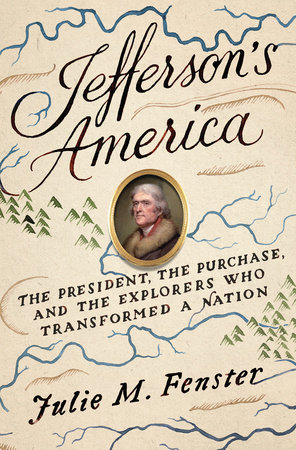
Jefferson's America: The President, the Purchase, and the Explorers who Transformed a Nation by Julie M. Fenster tells the story of the six men who first explored the new American territory west of the Mississippi River. When Thomas Jefferson first acquired the Louisiana Purchase, not everyone was impressed. Many thought it was more trouble than it was worth. There was some basis for this opinion, as there were no clearly marked borders between where American territory ended and Spanish territory began. This caused tensions between the two countries that almost led to war.
Jefferson chose to combat both the apathy of his own people regarding the land, and the tension with Spain in a somewhat unconventional way. Instead of a huge show of military strength, Jefferson sent explorers on four major expeditions. He hoped the explorers would bring back reports of the richness of the new land. He also wanted them to bring back examples of new plant and animal specimens so people could see the benefit of the new land for themselves. Jefferson hoped that once he had something to report, congress would give him more money for further exploration, and more people would be on board with his purchase.
The explorers were also told to establish contact with any native groups they came across. This was intended to establish both an American presence, and hopefully, dominance in their new land. Lewis and Clark are the men most remembered for their heroic journey to the Pacific and back. While they deserve credit for what they accomplished, there were other men who did just as much on their journeys. Zebulon Pike, Thomas Freeman, Peter Custis, William Dunbar, and Dr. George Hunter took just as many risks and did just as much for establishing American territorial borders and engaging the interest of the American people in their new land.
Jefferson's America offers a comprehensive and easily understandable look at the above men and their journeys. Each man (including Jefferson) gets the same level of treatment, as does each expedition. The importance of each is highlighted, as is the strength and weakness of each man. The motivations of the explorers is also discussed. Fenster gives a great overall look at the political, social, and economic, and international factors in play in the Louisiana territory during the early 1800s. I'd recommend this book to anyone interested in Thomas Jefferson, early American history, or exploration and the people who lead it.
Blogging for Books provided this book to me for free in exchange for an honest review. I was not required to write a positive review. The opinions I have expressed are my own. I am disclosing this in accordance with the Federal Trade Commission's 16 CFR, Part 255

Thursday, May 26, 2016

Unashamed: Drop the Baggage, Pick up Your Freedom, Fulfill Your Destiny by Christine Caine is a clarion call to women to live completely in the freedom that Christ has given them. Using her own story of living in and being set free from shame, Caine explains both how to break free from shame and why it is so important.
While the principles in this book are helpful to men as well, Unashamed is written specifically for women and addresses the unique shames that are inherent to women. Women have often been viewed as "less than" in many arenas. Caine herself faced these pressures as a young girl growing up who would rather excel at school and lead than learn to cook and clean house.
Caine shares her struggles and strategies in her lifelong struggle with shame. She consistently goes back to the freedom of Christ. Caine makes it clear that conquering shame is a process that has many levels and never ends. The freedom we are ready for now, is not as great as the freedom we'll be ready for a year from now. Because Satan comes to steal, kill, and destroy, he's constantly trying to steal our freedom and reassert shame's presence in our lives. That is why we must constantly set our minds on Christ and His word.
I recommend Unashamed for any woman, whether or not she thinks she struggles with shame. All of us deal with shame to some degree, and we often don't recognize it for what it is. Caine's honesty helps the reader feel less alone in her struggle. Her strategies are practical and easy to put to use. This will make a great gift for many!
I received this book free from Thomas Nelson Publishers as part of their BookLook book review bloggers program. I was not required to write a positive review. The opinions I have expressed are my own. I am disclosing this in accordance with the Federal Trade Commission's 16 CFR, Part 255
Tuesday, May 17, 2016
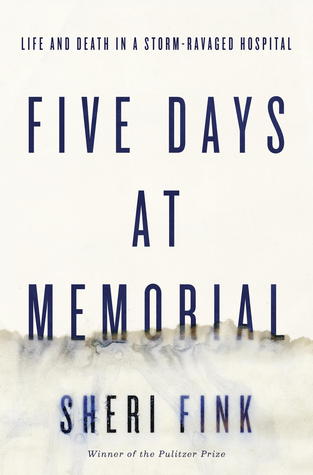
The first part of the book briefly mentions Memorial Medical Center's history, short biographies of the main players, and the preparations for and actual landfall of Hurricane Katrina. The rest of the section recounts what happened day by day as the staff struggled both to take care of patients in continuously deteriorating conditions as well as get everyone to safety. Using interviews, transcripts of official documents, and many other first person sources, Fink tells the story through a variety of people's perspectives. Both events and mindsets are discussed. Though one can never truly know what it was like to be there without having lived through it, Fink successfully conveys the sense of desperation that enveloped not just the hospital, but the city of New Orleans during this time.
The rest of the book details the investigation that took place into the deaths of about twenty of the forty-five patients that died during the covered five days. Fink details not just the events, but again the mindset and motivations of the major players, including the investigators, coroner, lawyers, and those three professionals who were eventually arrested. Fink does a masterful job of helping the reader understand the struggle each of these people went through regarding their role in this process. For many of them, it was life consuming.
Five Days at Memorial doesn't offer any tidy conclusions or opinions. Fink presents the available information, providing appropriate context, and lets the reader decide. I changed my mind at least half a dozen times as various perspectives and facts were presented. Five Days at Memorial does exactly what a great non-fiction book should do: it allows the reader to be in the situation as much as possible, and then lets him draw his own conclusions. I would thoroughly recommend Five Days at Memorial to anyone interested in medical ethics, disasters, Hurricane Katrina, or just a well written current event story.
Blogging for Books provided this book to me for free in exchange for an honest review. I was not required to write a positive review. The opinions I have expressed are my own. I am disclosing this in accordance with the Federal Trade Commission's 16 CFR, Part 255
Wednesday, May 4, 2016

This Is Awkward: How Life's Uncomfortable Moments Open the Door to Intimacy and Connection by Sammy Rhodes is a memoir of sorts. The author tackles subjects that are inherently awkward and affect many people's lives. He does this through the lens of his personal experience with each topic. Rhodes is brutally honest about past and present failings in his life, and how those awkward moments can build community and strengthen relationships.
Topics discussed include divorce, pornography addiction, and depression. Rhodes shares his personal experience with these and other "awkward" topics. The emphasis of the entire book is how important grace is, and how we can best receive it in our awkward and failed moments, if we're willing to be honest with others about them. Sprinkled throughout the book are excerpts of random paragraphs that Rhodes wrote while procrastinating while writing this book. They are often lighthearted and serve not only to add levity to serious topics, but also as a somewhat unfiltered look into the author's brain. It's another way of being vulnerable that serves to connect and help the reader relate to the author.
Overall, This is Awkward is a good book. It makes some solid points and is honest about a topic everyone can relate to. Introverts may find this especially relatable as the author clearly is one and some of his awkward moments are born out of that. There are two appendices at the end. One is "An Introvert's Guide to Surviving a Party" and the other is "A Social Media Manifesto."
I received this book free from Thomas Nelson Publishers as part of their BookLook book review bloggers program. I was not required to write a positive review. The opinions I have expressed are my own. I am disclosing this in accordance with the Federal Trade Commission's 16 CFR, Part 255
Wednesday, April 20, 2016
 Code 13 by Don Brown is the second installment of The Navy JAG series. Code 13 centers around the legality of a proposed drone project that has powerful advocates on both sides. Because of the billions of dollars that stand to be gained or lost depending on one's business ventures, various outside interest groups get involved to try and sway the legal opinion in their preferred direction.
Code 13 is better than the first book in this series (which I reviewed here). The characters weren't quite as oversized as before. There were definitely some overhanded and less than subtle statements and attitudes, but in this installment, there were at least hints of nuance. The overall plot was much tighter and easier to follow as well. The pace is fast and Brown does a good job of maintaining the suspense of what will happen next. While there is definitely room for improvement, Code 13 is much more like Brown's earlier works that I generally enjoy.
Anyone who enjoys military fiction will probably enjoy Code 13. Those interested in drones and how they can be used in various aspects of American life will also find this book interesting. It does raise interesting questions about where the line is between protecting Americans and violating their right to privacy. Overall, I wouldn't recommend this book to everyone, but there are some groups that will find it an interesting and enjoyable read.
I received this book free from Thomas Nelson Publishers as part of their BookLook book review bloggers program. I was not required to write a positive review. The opinions I have expressed are my own. I am disclosing this in accordance with the Federal Trade Commission's 16 CFR, Part 255
 Night Driving: A Story of Faith in the Dark by Addie Zierman is the story of the author's two week car trip with her two young sons from Minnesota to Florida and back. Zierman interweaves the events of her trip with her internal struggle of a period of darkness in her faith.
This is Zierman's second memoir. Her first, When We Were on Fire (which I reviewed here) recounts her journey out of the Christian culture bubble from adolescence to adulthood. Night Driving picks up a couple of years later when Zierman finds herself once again sinking into darkness and trying to escape. She can no longer "feel" God and is desperate to avoid the pit she previously fell into. Her solution is to literally escape the dreary winter of Minnesota in exchange for the sunny beaches of Florida, and hope that at the same time her spirit escapes the winter it finds itself in.
Night Driving is just as readable as Zierman's first book. While I didn't find myself personally relating to this one quite as much as I did the first, I still found a familiar story with elements that resonated. It can be a struggle for those who were brought up to believe faith was all about feeling to not get discouraged and depressed with the feelings disappear. It's not only something one learns to deal with as one matures in their faith, but is also something that often requires a deliberate frame of reference mind shift. Zierman's journey through this shift is honest and encouraging for any who may find themselves in the same position.
I would recommend Night Driving to anyone who may find themselves in a "winter" in their faith. It would also be helpful for anyone who doesn't understand how discouraging that can look and feel. Zierman's honesty allows the reader to take what they can, and leave the rest. There is no pretense to wade through. Night Driving is another great addition to the collection of the millennial memoir.
Blogging for Books provided this book to me for free in exchange for an honest review. I was not required to write a positive review. The opinions I have expressed are my own. I am disclosing this in accordance with the Federal Trade Commission's 16 CFR, Part 255
Friday, April 8, 2016

Qureshi states in the preface that he felt more comfortable addressing these questions individually rather than writing a book. However, he felt compelled to do so by the recent terrorist attacks in San Bernadino and Paris as well as the fiery responses to these attacks offered by certain American presidential candidates. As he says, "...lives are in the balance, and we must respond carefully. I cannot feign impartiality. Ignoring the reality of jihad endangers my nation, while responding with fear endangers my Muslim family" (11).
In Answering Jihad, Quershi provides a very understandable and basic explanation of both modern and historic Islam, jihad, and how people, specifically in the West, should respond to both. Using a question and answer form, Quereshi address eighteen questions he commonly gets asked, including "Is Islam a Religion of Peace?" and "How Does Jihad Compare with the Crusades?" Qureshi acknowledges that his treatment of each question is very basic and gives suggestions for resources that provide a more in depth look.
There are four appendices included at the end of Answering Jihad. They are "A Selective Timeline of Jihad in Islam," "Muhammad's Words on Jihad in Sahih al-Bukhari," "What Is the Caliphate?" and "Ahmadi Muslims and Details about My Former Sect of Islam." There is also a two page glossary of common Arabic and Islamic terms used throughout the book.
Overall I enjoyed Answering Jihad. I learned some important distinctions about subjects that are too often painted with a broad brush. This is a subject relevant to every American. Wherever one falls on the political spectrum, everyone can benefit from more information, and less fearful rhetoric. Answering Jihad is accessible enough to be a useful tool to aid in this conversation, therefore, I recommend it to anyone willing to more thoughtfully engage in this crucial topic.
I received this book free from Thomas Nelson Publishers as part of their BookLook book review bloggers program. I was not required to write a positive review. The opinions I have expressed are my own. I am disclosing this in accordance with the Federal Trade Commission's 16 CFR, Part 255
Subscribe to:
Posts (Atom)