Tuesday, December 1, 2015

The relationship between the Churchills and the Kennedys spanned three generations, two continents, and one world war. While the families briefly met socially in the late 1930s, their relationship really started when Joseph P. Kennedy was appointed the U.S. ambassador to the Court of St. James. When Lions Roar gives some background information on the patriarch of each family, but the majority of the book centers on the official roles that brought these two families together, and how those roles and relationships affected the relationship of the U.S. and Britain. It chronicles both the public and private ups and downs of the relationships mainly among Joe Kennedy Sr., Winston Churchill, Randolph Churchill, and John F. Kennedy, though other family members and their interactions are also mentioned.
When Lions Roar is a fascinating read. It is very well written and though it is full of detail and quotes from both spoken and written texts, the pace never gets bogged down. Maier focuses on two main relationships throughout this book. The main focus of course is on the relationship between the two families. However, there is a secondary focus on the relationship within each family, particularly that of father and son. How the two fathers interacted with their children was quite different. Towards the end of the book, Maier briefly explores how these different types of interactions produced very different kinds of sons.
Anyone interested in either family will find When Lions Roar a satisfying read. So will those interested in the relationship between the U.S. and Britain, especially leading up to and during WWII.
Blogging for Books provided this book to me for free in exchange for an honest review. I was not required to write a positive review. The opinions I have expressed are my own. I am disclosing this in accordance with the Federal Trade Commission's 16 CFR, Part 255

Monday, November 9, 2015

The Case for Hope: Looking Ahead With Confidence and Courage by Lee Strobel is an attempt to prove that true hope is real, if it is grounded in the person and work of Jesus Christ.
Lee Strobel is known for tackling subjects thoroughly and with an eye for truth and clarity that only a former journalist could have. Those who have read any of Strobel's previous works will find familiar content in this latest addition to his body of work.
Because the hope Strobel discusses is based on the person and work of Christ, he does spend some time discussing proof for the veracity of Christ's claims, though in a very condensed fashion. He spends the rest of the book discussing the relationship between hope and doubt, as well as telling stories of how this hope has changed people's lives, including his own.
While I normally don't comment on the aesthetics of a book, I feel compelled to this time. The overall feel of the cushy hard cover, and the blue color scheme somehow adds to the overall feel of hope that reading this book gave me. It almost has a gift book feel to it. It's rare for me to feel that way, but in this case, it was something I noticed from the very beginning.
Anyone who is a fan of Strobel will enjoy this book. I'd also recommend The Case for Hope to anyone who is investigating Christ and the claims of Christianity. This is a good primer on the basic facts. Christians who may be struggling to have hope or remember the reason for it will also benefit from reading this book.
I received this book free from Thomas Nelson Publishers as part of their BookLook book review bloggers program. I was not required to write a positive review. The opinions I have expressed are my own. I am disclosing this in accordance with the Federal Trade Commission's 16 CFR, Part 255
Monday, October 26, 2015

Accidental Saints: Finding God In All the Wrong People by Nadia Bolz-Weber is a collection of stories of grace made evident through an unlikely group of people. Bolz-Weber is a Lutheran pastor who founded House for All Sinners and Saints in Denver, Colorado. Most of these stories come from her interactions with people in that community.
Bolz-Weber's style is honest and raw, sometimes uncomfortably so. There is no element of the "safety" of anonymity in these stories. She shares them with her and others' brokenness out for everyone to see. She is unapologetic about her past or her present. While her transparency and openness are very appealing and winsome, there is a flip side to that. Her liberal use of offensive language completely turned me off at first. It took a conscience mental effort to set that aside, see past it, and learn form the truth of grace each story presents. Some people won't find it a problem, but for others, its something to be aware of. In the end, I'm glad I was able to set it aside and see the truth, because I benefited from it. However, I know some will be unable to do that, and its something I wish I had known in advance. Because I was completely unfamiliar with Bolz-Weber before reading this, it felt somewhat like an ambush.
Overall, each story told in Accidental Saints pushed against my experience and sense of grace. It did this in a good way, because it stretched me. I appreciate Bolz-Weber's willingness to point out how much more powerful (and real) grace looks, the messier the situation. Anyone who is ready and or willing to be pushed in the same way will benefit from reading Accidental Saints.
Blogging for Books provided this book to me for free in exchange for an honest review. I was not required to write a positive review. The opinions I have expressed are my own. I am disclosing this in accordance with the Federal Trade Commission's 16 CFR, Part 255
Friday, October 16, 2015

The Colson Way: Loving Your Neighbor and Living with Faith in a Hostile World by Owen Strachan is an examination of Chuck Colson's life focusing on his time as a Christian engaging politics in the public square. While Strachan briefly touches on Colson's early life, Watergate experience, and time in prison, the main focus is on his life after prison.
Strachan has two stated goals with this book. They are to tell "the overall story of Colson's life with special reference to the motivation and accomplishment of his public-square work," and to form "this historical material into a compelling model for Christian public witness and cultural engagement" (xxvi). Throughout the book, Strachan meets both stated goals. He is both passionate and compelling as he makes the argument for today's believers to engage the public square as consistently and ferociously as Colson did. Not all readers may agree with Strachan's stands, but it is hard to argue with his passion about engaging, however one choses to do so.
This is not a book for someone looking for a definitive work on Colson's life or his role in Watergate. The Colson Way is a call to America's Christians to stop hiding and begin engaging the public square. This is a helpful work for anyone interested in that whether they are not yet engaged, or have been doing so for a long time. It's encouraging to read about those who have gone before. Colson is a good example for today's believers. Hopefully, The Colson Way will make more people aware of him, and the legacy he left behind.
I received this book free from Thomas Nelson Publishers as part of their BookLook book review bloggers program. I was not required to write a positive review. The opinions I have expressed are my own. I am disclosing this in accordance with the Federal Trade Commission's 16 CFR, Part 255
Monday, September 28, 2015

Robert Bunch helped shaped Britain's views of the American South and it's "peculiar institution" during a time when the stakes were high. Britain had abolished slavery in its country and was attempting to end the slave trade world wide. This was one of their leading causes during this time, and most of the conflict in this area was occurring right where Bunch worked and lived. The delicate political situation of recognizing the Confederate States of America or not eventually led to Bunch's removal from Charleston.
Our Man in Charleston tells an interesting story, just not quite the one I expected. I expected it to be more espionage related, based on the title. However, Bunch was a diplomat through and through. While maintaining his personal views while at the same time maintaining relationships with those around him did require a certain amount of subterfuge, it was more diplomatic in nature. This book is heavy on description and narration, which makes its pace somewhat slow. Someone more interested in diplomatic maneuverings would probably appreciate it more than I did. I'd recommend this book to anyone interested in foreign involvement in American history in the fifty years or so leading up to the Civil War.
Blogging for Books provided this book to me for free in exchange for an honest review. I was not required to write a positive review. The opinions I have expressed are my own. I am disclosing this in accordance with the Federal Trade Commission's 16 CFR, Part 255
Thursday, September 3, 2015
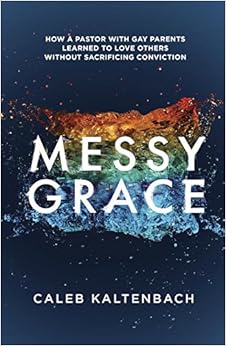
Messy Grace: How A Pastor With Gay Parents Learned to Love Others Without Sacrificing Conviction by Caleb Kaltenbach is Kaltenbach's story of supporting the truth of the Bible in a difficult, and for him very personal, area of life. As the title states, Kaltenbach is a pastor whose parents both identify as homosexual.
In Messy Grace, Kaltenbach tells his story of growing up with an out mother in a committed relationship and a closeted father. Growing up, he was taught that Christians hate people, and originally attended church hoping to better combat the hatred he saw hurled at his mother and her partner by Christians. To his surprise, he fell in love with Jesus and has spent his life since then pursuing and serving Him.
Kaltenbach does an excellent job of laying out both his opinions and experiences and what the scripture says about homosexuality. He encourages everyone to re-examine their own preconceived ideas in light of what scripture says. Kaltenbach offers a good mix of personal experience and general principals and practices. Each chapter includes discussion questions at the end for a deeper look. The main theme is that there is a tension between grace and truth that every believer must follow. Holding a traditional, biblical view of homosexuality does not give Christians permission to either ignore or treat badly those in the LGBT community. In fact, the Gospel argues the opposite approach must be taken. Kaltenbach offers practical suggestions about the two communities engaging and interacting with one another.
Not everyone will agree with Kaltenbach's views, which he readily admits. His main goal is to move the conversation a little farther along than it was before. Messy Grace is an easy and practical read that will benefit many all along the spectrum of this important issue. It's a good resource and recommendable to everyone.
Blogging for Books provided this book to me for free in exchange for an honest review. I was not required to write a positive review. The opinions I have expressed are my own. I am disclosing this in accordance with the Federal Trade Commission's 16 CFR, Part 255
Wednesday, August 26, 2015

The Printer and the Preacher: Ben Franklin, George Whitefield, and the Surprising Friendship that Invented America by Randy Petersen examines the somewhat unlikely friendship that spanned decades of each man's life. Using historical sources, including letters written between the men, Petersen lays out the trajectory of each man's life and how the overlap of their lives helped shape American history.
Petersen gives a thumbnail sketch of each man's life before their first interaction, but the majority of the book is spent discussing how Whitefield and Franklin influenced and helped one another. The way each life is presented, Petersen is trying to get the reader to see many parallels between them. He points out similarities in social standing, success, and thought, especially about engaging with and bettering one's community. The main difference was that Franklin thought the solution to all of society's woes was in civic engagement, and Whitefield thought the solution was Jesus.
The similarities Petersen points out are interesting, though some of them seem like somewhat of a stretch. Whitefield and Franklin did seem to have a symbiotic relationship that made both of them more successful than they could have been alone. It's clear they had a deep respect and affection for one another, though their opinions on many matters varied, sometimes widely. It's an overstatement to claim their friendship "invented America," but it does seem to have been an important relationship that is often overlooked when examining America's history.
The Printer and the Preacher is an interesting book about the friendship of two historically significant men. The pace is somewhat slow, and some of the connections feel forced. There is a fair amount of repetition and conjecture, though Petersen is good about pointing out what are just his thoughts. Overall, anyone who is a fan of early American history or of the first Great Awakening will find this an interesting, if not quite engaging, read.
I received this book free from Thomas Nelson Publishers as part of their BookLook book review bloggers program. I was not required to write a positive review. The opinions I have expressed are my own. I am disclosing this in accordance with the Federal Trade Commission's 16 CFR, Part 255
Subscribe to:
Posts (Atom)